
There are companies that operate efficiently, and then there are companies that are stewarded.
You can feel it almost instantly, that subtle but unmistakable sense that someone is still paying close attention.
Even when the founder's presence is rarely communicated directly, it's so embedded in the culture of decisions that you can feel someone at the helm still has emotional proximity to the customer. That decisions are still being made by someone capable of disappointment, pride, embarrassment, conviction, intuition.
And increasingly, that kind of stewardship feels rare.
Because modern entrepreneurship has glorified speed and efficiency above nearly everything else: scale quickly, raise capital, maximize visibility, optimize for growth. Bigger is synonymous with better. Funding is validation. Expansion means proof of relevance.
Yet somewhere in that cycle, many brands stop existing.
We've seen it happen over and over again. Brands arrive bright and magnetic, with a clear point of view and a devoted following. Then something shifts. The founder gets further from the customer. The business takes on pressure, investors, expectations, urgency. And eventually, the thing that made people care about the brand in the first place starts to disappear.
That's the tension I've been examining lately. Not the oversimplified narrative of "founders good, investment bad," but something more nuanced: what actually changes when the person at the helm is still close enough to obsess? What does it cost to care about the invisible details no spreadsheet would ever capture? What does it mean to answer to the customer instead of a boardroom?
One of the brands I think about a lot in this context is Aviator Nation.
What I love about Founder/CEO Paige Mycoskie is how much she seems to trust her gut and how little interest she has in doing what you're “supposed” to do. Her team is made up of people she likes, people she vibes with, people who understand her vision and know how to execute it. I met some people from her team before I really knew much about her, and what struck me was how clear they were on what she was building. There was no confusion about the point of view.
That matters to me.
Because when a founder's vision is clear enough, it starts to travel without her having to explain it every five minutes. The team understands it. The stores understand it. The customer feels it.
Aviator Nation is also unconventional in ways that would probably make plenty of traditional operators uncomfortable. The company makes its products in the U.S., even though financially that may not be the obvious choice. Their stores reflect things Paige actually cares about. She loves live music, so that gets baked into the business. Some of the stores have spaces where musicians can play. Her friends can come in and do sessions. The things she personally loves are not being stripped out in the name of efficiency. They become part of the brand.
Because care is expensive.
Not just financially, but psychologically. Care requires restraint. It requires attention. It requires saying no to things that might make sense on paper. It requires the discipline to prioritize what matters most instead of what looks most impressive.
Which leads to a stigma worth naming here.
Founder-led gets mistaken for feelings-first. For vibes over vigilance. For someone so emotionally attached to their vision that the spreadsheets become an afterthought. And that assumption is wrong, and honestly, a little condescending.
Caring deeply about a customer and caring deeply about profit are not in conflict. In fact, the second one is often what makes the first one possible.
That's another reason I find Aviator Nation so interesting. Paige has built a company that is highly profitable and has remained self-funded. She owns the business. She owns the stores. She has resisted the idea that growth has to mean giving up control.
What gets confused is the difference between emotional care and operational care. They're not the same thing.
Emotional care is knowing your customer. Knowing that a stylist is standing behind a chair, her reputation on the line with every install. Knowing that a bad experience doesn't just affect the client sitting in front of her, it affects the stylist's craft, her confidence, her relationship with a client she may have been building trust with for years.
I have that proximity. I think about the specific, human weight of every decision I make.
But operational care is something different. It's knowing what actually matters and what's just performance. It's understanding the difference between what feels like caring and what actually protects the thing you built.
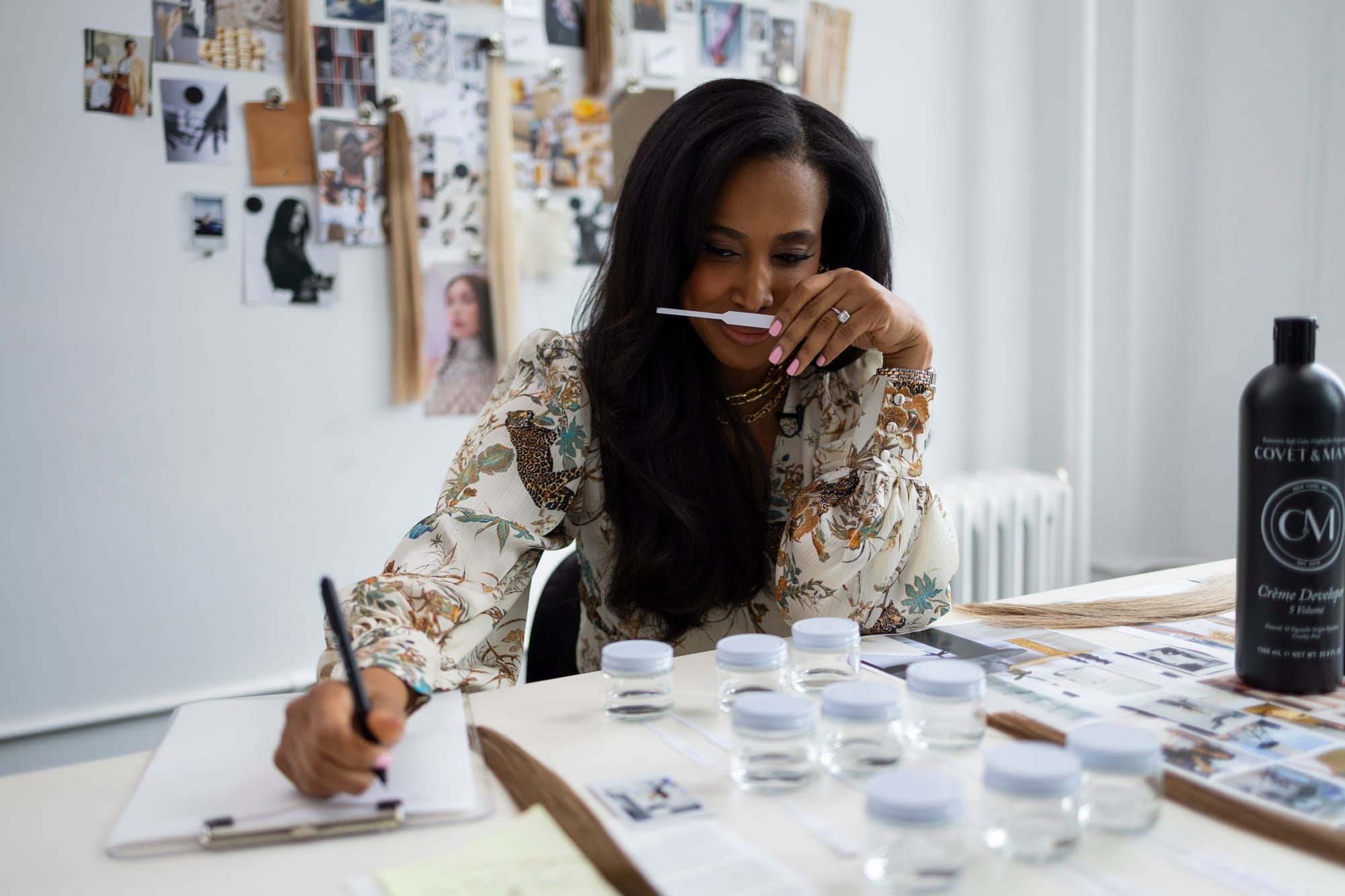
Obsessing over keratin melt points and water chemistry and root comfort, that's care. My team and I do that. And none of that is cheap or accidental. It requires profit to sustain.
Profit isn't the thing that compromises the mission. It's the thing that funds it.
A founder who prioritizes profitability isn't abandoning her customers. She's protecting her ability to keep showing up for them. On her own terms. Without someone else's timeline attached.
And I think that is part of what allows a founder like Paige to stay so deeply in the details without apologizing for it. She's passionate about the product. She's passionate about the experience. She's highly involved. And rather than treating that as a failure to “step back,” that proximity seems to be one of the things that has allowed the brand to remain so consistent.
She could also make herself the center of the brand if she wanted to. She fits the aesthetic. She could be everywhere. But she isn't.
And I think that's important because founder-led does not necessarily mean founder-famous.
The founder does not have to be the face of every campaign or turn herself into the product. Sometimes the founder's presence is most visible in the consistency of the decisions.
Someone is still there deciding what fits and what doesn't. What the company will spend money on and what it won't. Which opportunities are worth pursuing and which ones would pull the brand away from itself. Someone is still capable of feeling pride when the company gets it right and embarrassment when it doesn't. Someone still feels personally responsible for the promise.
To me, that is part of why founders matter.
It isn't simply that founders care more. It's that, at their best, they can provide a continuity of judgment that is incredibly difficult to manufacture.
So I think this is ultimately a reframing of three things:
First, care as an operational discipline. The ability to remain attentive enough to notice, refine, protect, and preserve what matters.
Second, profit as the thing that makes that care possible. Not the enemy of intention, but the protector of it. Profit gives a founder the patience, independence, and perspective to keep showing up on her own terms.
And third, the founder as a steward of consistency. Someone at the helm who remembers what the business promised in the first place and is still willing to make decisions in service of it.
Because when a business is profitable, it buys itself time. It buys the founder the ability to move slower, stay independent, protect quality, and resist the pressure to become bigger simply because the market demands it.
A profitable founder-led business may not always look the flashiest. But it endures because of that someone at the helm willing to say no. No to the celebrity campaign, the weekly floral subscription, the six-figure email agency, or whatever else looks impressive but does not actually protect the thing you built.
Sometimes what matters more is the product. Faster shipping. Better ingredients. Ethical sourcing. Reliable support. And actually listening to customer.
To me, that is stewardship.
Being a founder means holding responsibility for the value you set out to create and protecting the trust your customers placed in you.
This is not a romantic rejection of ambition or a deterrent to growth. I’ve just been thinking a lot about the economics and operational realities of care, profit as protection, and why having a founder at the helm who still feels responsible for the original promise may matter more than we give it credit for.