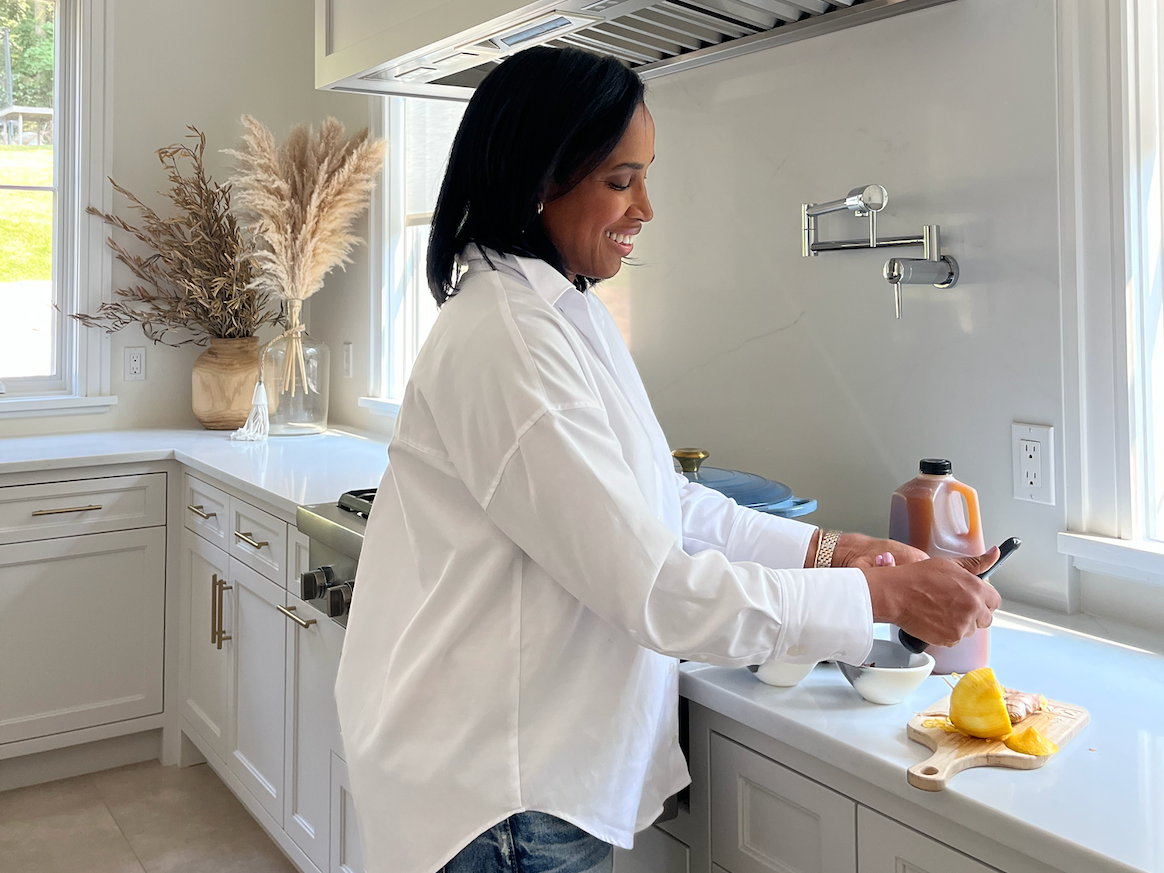

I run my businesses by quarters but I have stopped expecting myself to live that way.
I own businesses, so I understand the usefulness of quarters. First quarter, second quarter, third quarter, fourth quarter. Revenue targets. Budgets. Sales goals. Strategy sessions. Annual plans. KPIs. There is something very practical about dividing a business year into four equal parts and asking each one to produce something measurable.
Businesses need that kind of structure. They need deadlines and forecasts and ways to know whether what you are doing is actually working. But somewhere along the way, I think a lot of us started applying that same logic to ourselves.
January arrives and suddenly we are all supposed to be ready to go. New year, new goals, new routines, new body, new business plan. Wake up earlier. Lock in. Hit the ground running. And I have just never really felt that way in January.
Part of this may be because I grew up in brutally cold Minnesota and now live in the Northeast. I think living somewhere with real seasons conditions you to understand that nature has different expectations of you at different times of year.
When it is freezing outside, you wear a coat. When it gets dark at four-thirty, your life changes. You spend more time inside. Your energy changes. Your appetite changes. The things you want to do change. You cannot pretend it is July because the calendar says you should be productive.
So I think I have always had some intuitive understanding that there are times to expand and times to contract. Times to push and times to recover. Times to go out into the world and times to come home to yourself. I have just gotten much better at honoring that as I have gotten older.
Businesses have quarters. People have seasons.
And I think part of building a life you actually like is developing enough sensitivity to know which season you are in, and enough confidence to stop demanding that every season produce the same thing.
Winter is not nothing
January has never felt like my New Year.
December is probably the most exhausting month of my year. My entire immediate family has birthdays in December. There are holidays, hosting, gifts, corporate gifts, parties, endless school events, and all of the invisible work that somehow appears around making the holidays feel like the holidays. Then there are the end-of-year obligations of running a business.
By January, my social battery is dead. I do not want to go to a party. I do not particularly want to reinvent myself. I want the quiet permission of darkness and cold. I want to be in my own house.
For a long time, I think there was a part of me that believed I should fight that. January is the beginning of Q1. Serious businesspeople are supposed to come roaring back. There is almost a moral quality attached to how quickly you can get yourself “back on track.”
But I own my company. It is self-funded. I have more control over how I structure my life than most people do. Why would I use that freedom to force myself into a rhythm that does not actually work for me?
One of the gifts I have given myself is letting winter be winter.
The calendar tells me January 1 is a beginning. Nature tells me something very different. Look outside in January and almost nothing appears to be happening. The trees are bare. The ground is hard. Sometimes everything is covered in snow. But because I grew up around real winter, I know that nothing visible happening is not the same thing as nothing happening.
Things are dormant. They are conserving energy. They are repairing. Underneath frozen ground, things are preparing to grow again even though there is absolutely no evidence of it yet.
That rhythm makes much more intuitive sense to me than deciding that because the number at the end of the date changed, I should suddenly become the most productive version of myself.
Winter is when I naturally want to read more, think more, write more, and look back at the year that just happened. I want to understand what worked, what did not, what needs repairing, and what I might want to do differently. I do not stop working. I just stop expecting the same kind of work from myself. There is a difference.
And I think that distinction matters because we have become very bad at recognizing invisible progress. If there is not a launch, a metric, a transformation photo, a new goal, or something we can point to and say, “Look what I did,” we assume nothing happened.
But sometimes the work of a season is not visible. Sometimes the work is thinking, recovering, deciding what you no longer want, or getting quiet enough to hear yourself again.
There will be a time to push. For me, winter is not it.
Spring is when I want to move
Then spring comes and something changes. You start seeing bulbs come up. There are these little peeks and promises of color. The days get longer. People start emerging from their houses again. Everything begins stretching toward the light.
And I can feel the same thing happening in me. I get more focused, more ambitious, more interested in getting things done. So I lean into that too.
This is where I think honoring seasons is very different from simply giving yourself permission to do less. I do not want to do less all year. Sometimes I want to do a lot.
When the energy is there, I want to use it.
Spring becomes a really good time for me to push, execute, launch, make decisions, and get difficult things done. And part of the reason I can enjoy that intensity is because I am not pretending I am going to maintain exactly the same level of intensity for twelve months.
I know myself well enough to know what comes next. I want to play in the summer.
That knowledge actually makes me more disciplined in spring. There are things I want finished before summer. There are things I want launched. There are things I want off my desk because I know I am going to care less about sitting behind a computer when the sun is out at eight-thirty at night.
I think this is where some of our ideas about consistency become unnecessarily rigid. Consistency does not have to mean sameness.
I can be consistent about what matters to me over the course of a year without expecting myself to approach it with exactly the same energy in January, April, July, and October. Why would I expect that from myself when almost nothing else in nature works that way?
Maybe consistency is not producing at the same speed all year. Maybe consistency is staying in relationship with what matters, while allowing the way you tend to it to change.
Summer is for playing
Summer is a completely different kind of rest for me. It is not quiet. It is not particularly restorative in the traditional wellness sense. Honestly, sometimes I am exhausted. But it is playful.
My kids are out of school. For the past few years they have gone to sleepaway camp for part of the summer, and we have increasingly used summer for longer stretches of travel as a family. I love the late sunsets. I walk more. We are outside more. We eat later. There are more spontaneous plans.
And I especially love spending extended periods in another country because it forces me to use a different part of my brain. Everything is just unfamiliar enough. You are figuring out where to go, what to eat, how people live, sometimes trying to speak another language. There is novelty everywhere.
And I have realized that novelty is incredibly important to me.
For someone who spends so much of the year thinking about businesses, solving problems, making decisions, and being responsible for outcomes, there is something very useful about being somewhere where I am not trying to optimize anything.
I am not sitting at a café in Spain trying to have my next great business idea. Actually, the opposite. I want to stop trying to have the idea.
I do not believe all of our best thinking happens behind a computer. Mine certainly does not. Sometimes the best thing I can do for my work is get far enough away from it that my mind starts wandering somewhere else.
That is a different kind of productivity, although I almost hate calling it that because it turns play back into work. Sometimes play should just be play. Sometimes the value of a summer is that you were in your life. You saw things, you laughed, you stayed out too late, you wandered, you were interesting to yourself again.
Our company leans into summer too. Business naturally slows down. People are away. The media business gets quieter. We have summer Fridays every other week.
And yes, as someone who grew up in Minnesota and now lives in the Northeast, I remain suspicious of whether my friends in Los Angeles and Miami have earned summer Fridays. You have had summer all year. This is our time.
But the larger point is that I do not want to spend July fighting July. I have done that before. I have tried to impose the exact same expectations on every month of the year. At this point, I do not really understand what the prize is for winning that fight.
If you have done summer right, you eventually want your life back
This might be my favorite part of the cycle.
By late August, I am usually done. I have traveled. I have played. I have stayed up late. I have eaten out too much. Half my routines have disappeared. I have had enough novelty. And suddenly I want my house, my schedule, my routines, the kids back in school. I want to work.
I actually think there is something really beautiful about reaching the end of a vacation, or even an entire season of play, and realizing you do not want to escape your real life indefinitely. You miss it. That feels important to me.
Because so much of the way we talk about a “good life” is built around escape. The vacation. The weekend. The sabbatical. The fantasy of not having to work.
But one of the questions I am increasingly interested in is whether you have built a life you eventually want to come home to.
If you have done summer right, vacation is wonderful. And then your real life starts sounding pretty good again.
That is why Labor Day has always felt much more like my New Year than January 1. By September, I am ready. Not because someone told me this is when I should be ready, but because I actually am.
Fall is when I lock in
Fall is probably my favorite working season.
Everything comes back at once. School starts. New York comes alive again. People return from vacation. Events start. There are dinners and conferences and back-to-school things and birthdays.
It is probably my most social season too, which somehow works because after summer I have the appetite for it again. And professionally, I want to get shit done.
But even then, I do not think of fall as a period of indiscriminate creation. If I am going to continue abusing the gardening metaphor, fall is harvest.
By October, I usually have a pretty clear understanding of what kind of year we are having in the businesses. Most of the year is booked. Barring some enormous surprise in December, I can see where we are going to land.
That is why I love doing strategy sessions in October. What grew? What is ripe? What worked? What is making money? What did not work? What needs to be tweaked? What do we absolutely not need to do again next year?
This is probably where I differ from some of the constant-innovation culture around business. I do not think fourth quarter is necessarily the time to invent a bunch of new shit. Do what works.
Focus on what is making money. Finish what you started. Tweak what is not working. Get back into the routines that make the business run well. Harvest what you spent the rest of the year growing, then start thinking about what you might want to plant next.
There is a kind of maturity in not needing every season to be about beginning something. Some seasons are for finishing. Some are for collecting the return on what you already built. Some are for noticing that something worked and having enough discipline not to ruin it by immediately replacing it with something new.
My life has seasons too
Once I started seeing my year this way professionally, I realized I was already doing it everywhere else.
My social energy is seasonal. I can happily have a dinner, an event, a school thing, and another dinner in the same week in October. Ask me to do that in January and I will resent everyone involved.
My relationship with technology changes. There are seasons when I am interested in new tools and using technology to help me execute more efficiently. And there are other times, especially when I am traveling, when I want to block as much of it as possible and keep only what I need to navigate my life.
My movement changes. My eating changes. My clothes change. The books I want to read change. Even the way I think seems to change.
For a long time, I think I saw some of those shifts as inconsistency. Now I mostly see them as information.
This is how I work.
And once you know that about yourself, you can actually plan for it instead of being perpetually surprised by yourself.
That, to me, is one of the real benefits of paying attention to your seasons. It gives you information about your own life.
Maybe you are not lazy. Maybe you are depleted. Maybe you have not lost your ambition. Maybe you are in a season that is asking you to turn inward. Maybe the thing that felt effortless six months ago genuinely requires more energy now because your family changed, your health changed, your work changed, or you changed.
And maybe instead of immediately trying to correct yourself, you can ask a better question: What does this season require of me? And just as importantly, what does it not require?
I do not want to run my life like a corporation
I think this is the part that bothers me most about the way we talk about productivity now.
So much corporate language has quietly infiltrated our personal lives that we barely notice it anymore. We have quarterly goals and KPIs and optimization and efficiency and performance and growth. We measure our sleep. We measure our steps. We measure our output. We turn hobbies into side hustles and morning routines into performance systems. Somehow even rest has become something we are supposed to optimize so that we can come back and produce more.
And listen, I am not anti-any of this. I have goals. I track things. I love systems. I literally run companies. But I do not want to become one.
I do not want the only measure of whether January was valuable to be how much I produced in January. I do not want a summer spent traveling with my family to register in my mind as a productivity decline. I do not want to look at a period when I am reading and thinking and not producing very much and assume that nothing is happening.
Sometimes nothing visible is happening. That does not mean nothing is happening.
I think one of the privileges of being a human being is that we get to respond to something more organic than a calendar. We get to notice our energy, our families, where we live, the weather, our bodies, what season of life we are actually in.
Maybe the goal is not to overcome all of those things in the name of consistency. Maybe the goal is to build a life flexible enough to respond to them.
I would rather live in a cycle than on a treadmill
The older I get, the more interested I am in working with these rhythms instead of constantly trying to override them.
Winter gives me permission to go inward. By spring, I am ready to move. Summer pulls me out into the world. By fall, I am ready to come back and work. Then it happens again. There is something reassuring about thinking about a year this way because it means I do not have to demand everything from myself at once.
If I am tired in January, I do not need to panic that I have lost my ambition. If I am distracted by travel and my children and beautiful weather in July, I do not need to engineer a more disciplined version of summer. If September makes me want to reorganize my entire life, make lists, start projects, and lock in, I can use that too.
I am not lowering my expectations for myself. I am getting better at understanding when different versions of me tend to show up, and then building my life around the reality of that instead of the fiction that I should be exactly the same woman 365 days a year.
And I think that is what I want you to take away:
Not that your seasons have to look like mine. Maybe January is when you come alive. Maybe summer is your most productive period. Maybe you live somewhere without dramatic changes in weather and your seasons have nothing to do with temperature at all.
Your seasons might be defined by motherhood, building a company, grief, healing, falling in love, caring for someone, having very little money, finally having enough, wanting to be everywhere, or wanting to disappear for a while and make something.
There is a kind of self-trust in being able to say: this is the season I am in, this is what it is asking from me, and I am going to stop fighting it long enough to see what it has to give me.
My businesses still have quarters. They have budgets, goals, forecasts, KPIs, and deadlines. I need them to.
But I do not need to be one.
I have seasons.